
The world’s most extraordinary unfinished cathedral reaches toward heaven, defying time, expectations, and architectural conventions. This is your complete guide to Barcelona’s crown jewel.
Table of Contents
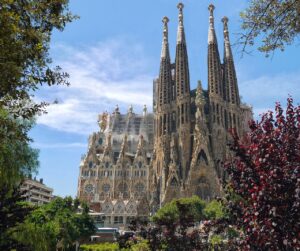 Standing before the Sagrada Família feels like witnessing architecture’s answer to time travel. This isn’t just a church—it’s a 144-year-old construction site that has become humanity’s most beautiful act of faith. Since 1882, five generations have watched Antoni Gaudí’s vision slowly emerge from stone, creating what art critic Rainer Zerbst called “probably impossible to find in the entire history of art.”
The numbers tell an incredible story: over 4.5 million visitors annually, making it Spain’s most visited monument. Yet despite its fame, the Sagrada Família guards secrets that most tourists never discover. This guide unlocks them all.
Bottom Line Up Front: The Sagrada Família represents the greatest architectural project of our time—a UNESCO World Heritage site that blends Gothic ambition with Art Nouveau innovation, scheduled for completion in 2026, exactly 100 years after Gaudí’s death.
History & Origins: The Bookseller’s Dream That Changed Architecture
The Unexpected Beginning (1882-1883)
The Sagrada Família’s origin story reads like fiction. In 1872, a Barcelona bookseller named Josep Maria Bocabella visited the Vatican and returned with an audacious dream: to build a church inspired by the basilica at Loreto. On March 19, 1882—the feast of St. Joseph—Bishop Urquinaona laid the cornerstone of what would become the world’s most famous unfinished building.
The original architect, Francisco de Paula del Villar, envisioned a standard neo-Gothic church with ogival windows, buttresses, and pointed bell towers. But fate intervened. After disagreements over costs and design, del Villar resigned on March 18, 1883. Enter Antoni Gaudí, a 31-year-old architect who would transform this modest project into an architectural revolution.
Gaudí’s 43-Year Obsession (1883-1926)
When Gaudí assumed control, he didn’t just modify del Villar’s plans—he reimagined the entire concept. “My client is not in a hurry,” Gaudí famously remarked, understanding that his vision would outlive him. He was right.
Gaudí dedicated the final 12 years of his life exclusively to the Sagrada Família, living in a workshop on-site. By his death in 1926, less than 25% of the basilica was complete, including the crypt, apse, and one bell tower—the Saint Barnabas tower on the Nativity Façade, the only part he would see finished.
Survival Through Tragedy
The Spanish Civil War (1936-1939) nearly destroyed Gaudí’s legacy. On July 18, 1936, anarchist militants stormed the construction site, burning Gaudí’s original plans, photographs, and smashing his plaster models. What could have been the end became a testament to human determination. Architects painstakingly reconstructed his designs from surviving fragments, published photographs, and model pieces.
The Digital Renaissance (1980s-Present)
The introduction of computer-aided design in the 1980s revolutionized construction. What once required hand-carving now benefits from CNC milling machines that shape stone off-site with millimeter precision. This technological leap accelerated progress dramatically—construction passed the midpoint in 2010.
Timeline of Major Milestones:
- 1882: Construction begins under del Villar
- 1883: Gaudí takes control
- 1925: First bell tower completed (Gaudí’s only finished tower)
- 1936: Civil War damage and destruction of plans
- 1952: Construction resumes post-war
- 1984: UNESCO World Heritage designation
- 2010: Pope Benedict XVI consecrates the basilica
- 2021: Tower of the Virgin Mary completed (138 meters)
- 2026: Projected completion date
Architecture & Design: Nature Made Stone
Gaudí’s Revolutionary Vision
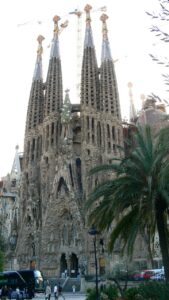 Gaudí rejected the architectural orthodoxy of his era, declaring “straight lines belong to men, curved lines belong to God.” The Sagrada Família embodies this philosophy, featuring not a single straight line in its interior design. Instead, Gaudí created a “forest of faith” where columns branch like trees and vaults curve like leaves catching sunlight.
The Mathematical Miracle
Behind the organic beauty lies sophisticated mathematics. Gaudí employed ruled surfaces including hyperboloids, parabolas, helicoids, and conoids—complex geometries that create structurally sound forms while enhancing acoustics and light quality. His innovative hanging chain models (funicular models) determined optimal angles for columns and arches, visible today in the slanted columns of the Passion Façade.
The Three Sacred Façades
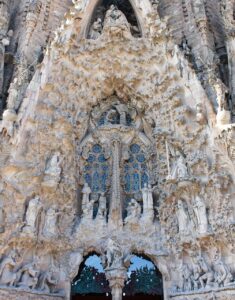
Nativity Façade (East): The Celebration of Life
Completed largely during Gaudí’s lifetime, this façade explodes with natural detail. Every sculpture, animal, and plant was cast from life—Gaudí used real donkeys, roosters, and local flora as models. The result is a stone encyclopedia of Mediterranean life celebrating Christ’s birth.
Hidden details to spot:
- A tortoise and chameleon supporting columns (symbolizing land and sea)
- The genealogy of Christ carved in stone
- Over 100 plant and animal species represented
- The only façade with Gaudí’s direct input on every detail
Passion Façade (West): The Geometry of Suffering
 Sculptor Josep Maria Subirachs (an atheist who lived in the basilica while working) created this stark, angular façade representing Christ’s crucifixion. The deliberate contrast with the Nativity Façade creates a powerful narrative arc from birth to death.
The famous Magic Square: Every row, column, and diagonal adds up to 33—Christ’s age at death. This mathematical Easter egg demonstrates the precision behind apparent chaos.
Glory Façade (South): Heaven’s Gateway
Still under construction, this will be the main entrance representing resurrection and eternal life. The completed doors already display the Lord’s Prayer in over 50 languages, symbolizing Christianity’s universal message.
The Eighteen Towers: A Biblical Hierarchy
When complete, 18 towers will pierce Barcelona’s skyline:
- 12 towers: The Apostles (4 per façade, 100m tall)
- 4 towers: The Evangelists (120m, topped with their traditional symbols)
- 1 tower: Virgin Mary (138m, completed in 2021)
- 1 central tower: Jesus Christ (172.5m, under construction)
The Christ tower will make the Sagrada Família the world’s tallest church, surpassing Germany’s Ulm Minster by 11 meters. Gaudí deliberately kept it one meter shorter than Barcelona’s Montjuïc hill, believing “no human creation should surpass God’s work.”
Hidden Symbolism & Secrets: The Bible in Stone
Gaudí’s Theological Architecture
Gaudí intended the Sagrada Família as “the Bible made of stone”—a visual scripture for Barcelona’s largely illiterate working class. Every element carries religious significance, creating layers of meaning that reward careful observation.
The Forest Cathedral Interior
Step inside and you’re in Gaudí’s vision of Eden. The 36 interior columns represent saints, apostles, and continents, each topped with lamps displaying relevant symbols. The four central columns honor the Evangelists with their traditional symbols:
- Matthew: Winged man
- Mark: Winged lion
- Luke: Winged ox
- John: Eagle
The branching columns create a stone forest canopy that mimics how light filters through leaves. This isn’t coincidence—Gaudí studied Mediterranean pine forests to perfect the effect.
Light as Divine Language
The stained glass windows function as a theological color wheel. Eastern windows glow with warm yellows and reds (symbolizing Christ’s birth and resurrection), while western windows feature cool blues and purples (representing death and passion). As the sun moves across the sky, the interior experiences a daily journey from hope to sorrow to hope renewed.
Sacred Numerology Hidden in Plain Sight
Numbers permeate the design:
- 7.5 meters: The basic module determining all proportions
- 33: Christ’s age (the Magic Square, vault heights)
- 12: Apostles (towers, altar candles)
- 4: Evangelists (towers, cardinal directions)
Natural Symbols Everywhere
Gaudí embedded over 100 species of Mediterranean flora and fauna in the façades:
- Grapes and wheat: Eucharist symbols
- Doves: Holy Spirit and peace
- Pelicans: Christ’s sacrifice (pelicans were believed to feed chicks with their own blood)
- Turtles and tortoises: Supporting columns (land and sea)
The Secret Gaudí Portraits
Look carefully and you’ll find Gaudí himself sculpted into both completed façades:
- Nativity Façade: As Saint Joseph
- Passion Façade: As Saint John, the apostle who never abandoned Christ
Essential Visitor Information: Planning Your Pilgrimage
Ticket Booking: The Golden Rules
Book online 2-3 months in advance—this cannot be overstated. The Sagrada Família sells out regularly, especially April through September. Day-of tickets are extremely rare and subject to availability.
Official ticket prices (2025):
- Basic entry + audioguide: €26 (adults)
- With tower access: €36 (adults)
- Students/Seniors: €24 (proof required)
- Children under 11: Free
- Disabled visitors: Free (plus one companion)
Pro tip: Wednesday-Friday afternoons offer half-price tickets for visitors under 30, two hours before closing.
Opening Hours by Season
November-February:
- Monday-Saturday: 9:00 AM – 6:00 PM
- Sunday: 10:30 AM – 6:00 PM
March & October:
- Monday-Friday: 9:00 AM – 7:00 PM
- Saturday: 9:00 AM – 6:00 PM
- Sunday: 10:30 AM – 7:00 PM
April-September:
- Monday-Friday: 9:00 AM – 8:00 PM
- Saturday: 9:00 AM – 6:00 PM
- Sunday: 10:30 AM – 8:00 PM
Getting There: Multiple Routes
- Metro: Sagrada Família station (L2 Blue line, L5 Blue line) – 1-minute walk
- Bus: Lines 19, 33, 34, B24, D50, H10
- Car: Parking very limited; use Plaça de la Sagrada Família underground garage
- Walking: 40 minutes from Las Ramblas through beautiful Eixample district
Three Entrances Explained
- General Entrance: Nativity Façade, Carrer de la Marina (main entrance)
- Group Entrance: Nativity Façade left side (10+ people)
- School Entrance: Exclusive to educational groups
What’s Included vs. Extra Costs
Basic ticket includes:
- Basilica access
- Museum and crypt
- Official audioguide app (19 languages)
- “What You Don’t See” augmented reality experience
Additional costs:
- Tower access: +€10 (highly recommended)
- Guided tours: +€15-25
- Combined tickets: Varies by package
Photography & Best Times to Visit
The Golden Hours of Light
The Sagrada Família transforms throughout the day as natural light plays across its surfaces. Timing your visit around these “magic hours” dramatically improves your experience:
Morning (9:00-11:00 AM):
- Nativity Façade glows with golden eastern light
- Interior receives warm, hopeful illumination
- Fewer crowds for better photos
- Ideal for exterior shots
Late Afternoon (4:00-6:00 PM):
- Passion Façade dramatically lit by western sun
- Interior explodes with colored light from stained glass
- Peak photography time for interior shots
- Moderate crowds
Photography Rules & Equipment
Allowed:
- Personal cameras and smartphones
- Wide-angle lenses (essential for interior)
- Video recording for personal use
Prohibited:
- Flash photography (damages artwork)
- Tripods and selfie sticks
- Professional equipment without permission
- Drones anywhere on grounds
Recommended camera settings:
- Interior: ISO 800-1600, wide aperture (f/2.8-f/4)
- Exterior: ISO 100-400, moderate aperture (f/8-f/11)
- Stained glass: Shoot into the light, bracket exposures
Best Photography Spots
- Interior ceiling shots: Use ultra-wide lens, point straight up
- Stained glass windows: Late afternoon, eastern and western walls
- Column forest: Various angles showing branching effect
- Nativity Façade details: Morning light, close-up lens
- Passion Façade drama: Afternoon shadows, strong contrast
- Tower views: City panorama (if visiting towers)
Insider Tips & Practical Advice
Dress Code Requirements
As an active Catholic basilica, modest dress is mandatory:
- Cover shoulders and knees
- No see-through clothing
- No swimwear or beach attire
- Religious respect appreciated
Time Management Strategy
- Minimum visit duration: 1.5 hours
- Recommended duration: 2-3 hours
- With towers: Add 45-60 minutes
Suggested timeline:
- 30 minutes: Exterior façade examination
- 45-60 minutes: Interior exploration with audioguide
- 30 minutes: Museum and crypt
- 45 minutes: Tower visit (if included)
Crowd-Beating Strategies
- First entry slot (9:00 AM) has fewest crowds
- Weekday mornings significantly less busy than weekends
- Late afternoon slots offer better light but more people
- Winter months (November-February) least crowded
Money-Saving Tips
- Barcelona City Pass: Includes Sagrada Família + Park Güell + public transport
- Student discounts: 50% off with valid international student ID
- Free entry: Sunday morning mass (arrive by 8:00 AM)
- Off-season visits: Lower accommodation costs, same ticket prices
Common Mistakes to Avoid
- Not booking in advance: Risk being shut out entirely
- Missing your time slot: No refunds, must buy new tickets
- Rushing the visit: This deserves slow, contemplative viewing
- Ignoring the museum: Contains crucial context and Gaudí artifacts
- Skipping the audioguide: Miss 90% of the symbolism and stories
Accessibility Information
- Wheelchair accessible: Main basilica and museum
- Tower access: Not suitable for mobility issues (narrow spiral stairs down)
- Audio support: Sign language guides available
- Visual impairment: Special tactile tours by arrangement
2026 Completion: The Final Chapter
What’s Left to Build
The Tower of Jesus Christ remains the final major element, currently rising toward its ultimate height of 172.5 meters. When complete, it will feature:
- 17-meter crystal cross at the summit
- Interior elevator access for visitors
- Panoramic viewing platform
- Illumination system visible across Barcelona at night
The Centenary Celebration
2026 marks exactly 100 years since Gaudí’s death, making the completion date profoundly symbolic. The finishing touches may continue until 2034, but the main structure will be complete, ending the longest construction project in modern history.
Economic Impact
The Sagrada Família generates over €20 million annually for Barcelona’s economy through tourism. Completion will likely increase this figure dramatically, cementing Barcelona’s position as Europe’s most architecturally significant city.
Frequently Asked Questions
Can I visit the Sagrada Família without booking in advance?
Highly unlikely, especially March-October. Same-day tickets are rare and subject to availability. Online booking 2-3 months ahead is essential.
Is the tower visit worth the extra cost?
Absolutely. The spiral staircases, construction views, and city panorama provide unique perspectives impossible to get elsewhere. Not suitable for claustrophobia or mobility issues.
How long does a typical visit take?
1.5-3 hours depending on interest level. Allow extra time if visiting towers or taking guided tours.
Are guided tours better than the audio guide?
Both have merits. Guided tours offer interaction and expert insights; audio guides provide flexibility and detailed information. Many visitors find the included audio guide sufficient.
What’s the best time of year to visit?
April-May and September-October offer ideal weather and manageable crowds. Summer is busiest but has longest hours. Winter has smallest crowds but shorter days.
Is photography allowed inside?
Yes, personal photography and video are permitted. No flash, tripods, or professional equipment without special permission.
Will the 2026 completion change the visitor experience?
The main structure will be complete, but ongoing detail work may continue until 2034. The essential experience—façades, interior, towers—will remain unchanged.
Final Thoughts: A Living Prayer in Stone
The Sagrada Família transcends typical tourist attractions. This is architecture as spiritual experience, where every stone tells a story and every shadow carries meaning. Gaudí created more than a church—he crafted a meditation on faith, nature, and human creativity that continues evolving after 144 years.
Whether you’re an architecture enthusiast, photography lover, or spiritual seeker, the Sagrada Família offers revelations that unfold with each visit. As the completion date approaches, we’re witnessing the final chapters of humanity’s most ambitious act of architectural faith.
Book your tickets now—not just to see a famous building, but to participate in a miracle that refuses to end.
The Sagrada Família is located at Carrer de Mallorca, 401, 08013 Barcelona. For official tickets and information, visit sagradafamilia.org.